Working Backwards
Start with the desired customer experience and work backwards- harder than it sounds, but a clear path to innovating and delighting customers. ~ J. Bezos

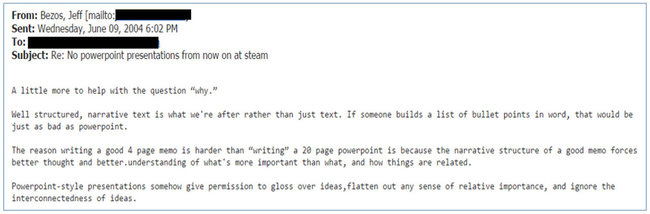
The email from Jeff Bezos that officially banned the use of PowerPoint at Amazon and insisted that people with ideas come to meetings with “well structured, narrative text”
The Working Backwards process is a huge amount of work. But it will save you even more work later on ~ Jeff Bezos
What is a Working Backwards?
Working Backwards is a systemic approach designed to critically evaluate ideas and guide the development of new products by focusing foremost on the desired customer experience. The fundamental principle is to envision the end-state customer experience and progressively trace the steps required to realize it, ensuring clarity and focused intent in the product development journey. Central to this methodology is the written narrative PR/FAQ document; short for press release/frequently asked questions.
The PR/FAQ stands at the forefront of the product discovery process, acting as the linchipin for unified understanding among all stakeholders. It serves as the foundational reference from which all subsequent product documentation is derived
The primary point of the process is to shift from an internal/company perspective to a customer perspective. The PR gives the reader the highlights of the customer experience. The FAQ provides all the salient details of the customer experience as well as a clear-eyed and thorough assessment of how expensive and challenging it will be for the company to build the product or create the service. The PR/FAQ process creates a framework for rapidly iterating and incorporating feedback and reinforces a detailed, data-oriented, and fact-based method of decision-making. The PR is a few paragraphs, always less than one page. The FAQs should be five pages or less.
The process of Working Backward starts with 5 questions:
Who is the customer? Consider the time, place, and situation.
What is the customer problem or opportunity? Specify a problem you are going to solve. Define the size of the problem.
What is the most important customer benefit? Prioritize what the customer values.
How do you know what customers want or need? Recognize that your personal experiences may not be representative of customers. Challenge yourself to use data to back your thinking.
What does the customer experience look like? Whiteboard sketch. Storyboard. User journey map. Wireframe. Technical architecture diagram
How to write PR FAQ document? (see Resources → Template PRFAQ)
Writing forces clarity of thought in a way nothing else can. Effective writing, often an underrated skill in business, plays a critical role in clarifying thoughts and communicating complex ideas succinctly and clearly. The PR-FAQ, is a fundamental tool in product development and strategic planning. PR/FAQ is writing as the first step of a proposal, for something that doesn’t exist yet, for something you want to build. It’s written from the point of view of the customer.
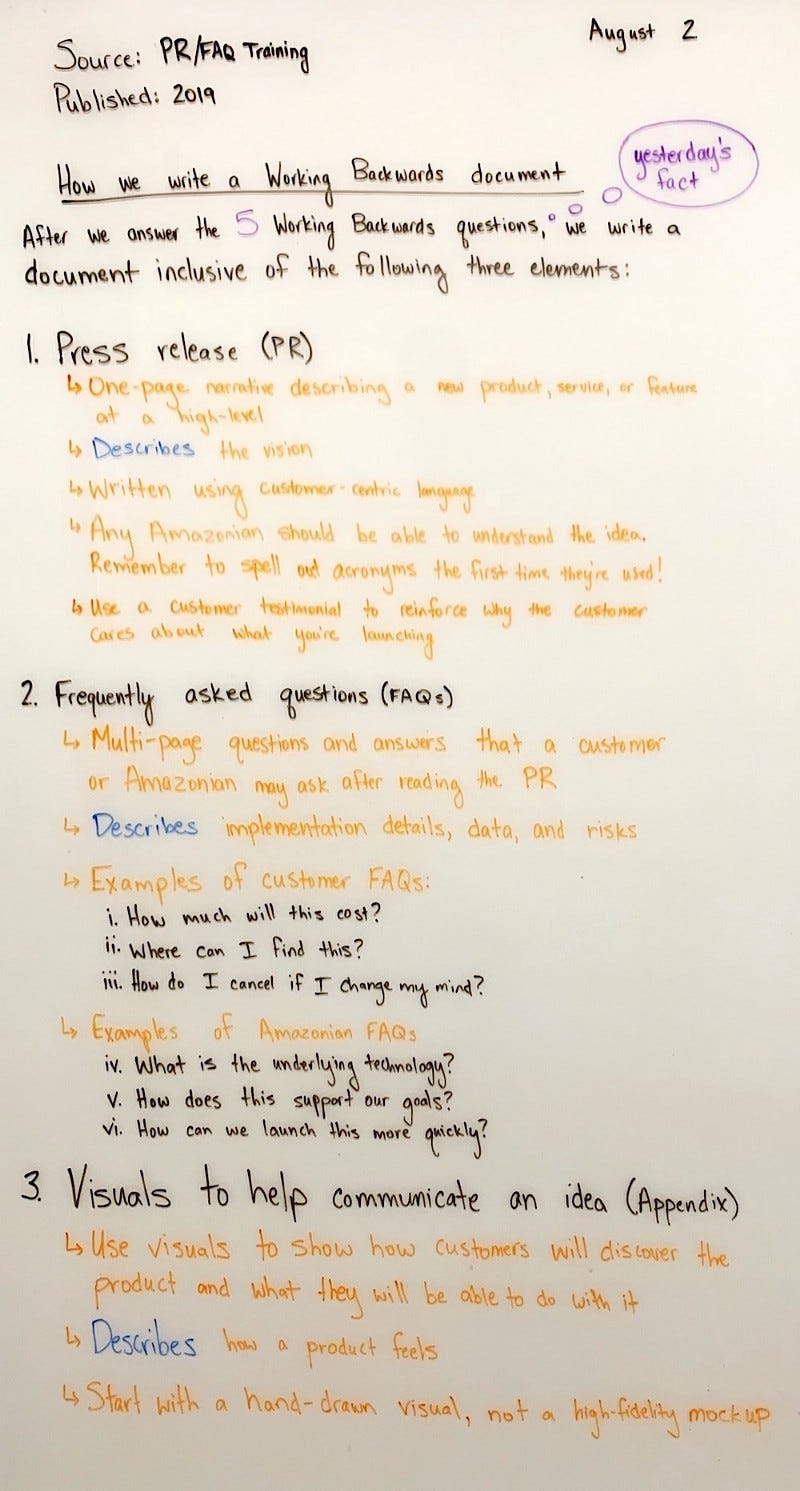
After you answer the 5 Working Backward questions, write a document inclusive of 3 components.
Press Release – written from the future point-of-view. A hypothetical press release that might be written when the new product or service is actually release. It’s like a litmus test for the product. If this press release doesn’t convince someone to buy the product, then it needs to be rewritten.
Frequently Asked Questions – External FAQ is a list of potential questions customers or the press might have about the product documentation that is released at the same time as the PR. Internal FAQ is similar to external FAQ, but longer and with hard questions internal stakeholders may ask the product development team. They answer any questions from internal stakeholders that have come up during the product development process. It includes all concerns, challenges, alternatives and potential risks.
Appendix – additional documents or material to support the PRFAQA. It can include mockups, timelines, storyboard, other related content etc.
Remember writing, reading, reviewing go hand in hand. If implementing this practice in the workplace it is important that people also read, review, and provide feedback when a PRFAQ is written. Requiring teams to write without effective reading and feedback by leadership and stakeholders is wastage of talent in the workplace.
See this clip from ‘Genius’ that underscores the importance of effective writing, reading & feedback:
Resources:
Working Backwards – Book.Bill Carr & Colin Bryar
PRFAQ Template in Coda
Example PRFAQ - SVPG
Example PRFAQ - GitHub
Example PRFAQ - Notion AI
Working Backwards – a16z podcast
Working Backwards Approach – video
How to write a Working Backwards document: